Choosing the right digital marketing strategy can be confusing for business owners. You want more website visitors, better leads, and increased sales without wasting your marketing budget. Two popular ways to achieve these goals are Search Engine Optimization (SEO) and Google Ads.
SEO vs Google Ads: Which Works Better? The answer depends on your budget, business goals, competition, and how quickly you want to see results. Both strategies help businesses reach people searching online, but they work differently.
In this guide, we will compare SEO and Google Ads, explain their benefits and limitations, and help you choose the right option for your business.
What Is SEO?
Search Engine Optimization, commonly known as SEO, is the process of improving your website so it can appear higher in the organic search results on Google and other search engines.
SEO focuses on making your website useful, relevant, technically accessible, and easy for search engines to understand. It includes keyword research, content creation, on-page optimization, technical improvements, and earning relevant backlinks.
For example, if you run a digital marketing agency, you may optimize your website for searches such as “digital marketing services” or “SEO services for small businesses.”
When your website ranks well, potential customers can discover your services through unpaid search results.
Benefits of SEO
- Long-term visibility: Strong rankings can continue attracting visitors over time.
- No payment per click: You do not pay Google every time someone clicks an organic result.
- Builds trust: Many users view relevant organic results as useful sources of information.
- Supports brand awareness: Helpful articles can introduce your business to potential customers.
- Improves your website: SEO encourages better content, navigation, and user experience.
Limitations of SEO
SEO usually takes time. Depending on your website, competition, and strategy, meaningful improvements may take several months. Rankings are not guaranteed, and ongoing optimization is often necessary.
What Are Google Ads?
Google Ads is Google’s paid advertising platform. Businesses can create advertisements that appear in search results and other placements, depending on their campaign type.
For example, a company offering website design services can advertise when people search for “hire a website designer.” The advertiser may pay when someone clicks the search ad, depending on the bidding strategy and campaign setup.
Google Ads allows businesses to target relevant search terms, locations, audiences, and other campaign settings.
Benefits of Google Ads
- Faster visibility: Eligible ads can start appearing after campaign approval and launch.
- Targeted traffic: Campaigns can reach people searching for specific products or services.
- Budget control: You can set campaign budgets and adjust bids.
- Measurable results: Tracking can help you assess clicks, leads, conversions, and costs.
- Flexible testing: You can test different keywords, ad copy, and landing pages.
Limitations of Google Ads
Google Ads requires ongoing spending. Once your ads stop running, the paid traffic they generate generally stops as well. Poor keyword selection, weak landing pages, and ineffective campaign settings can also waste money.
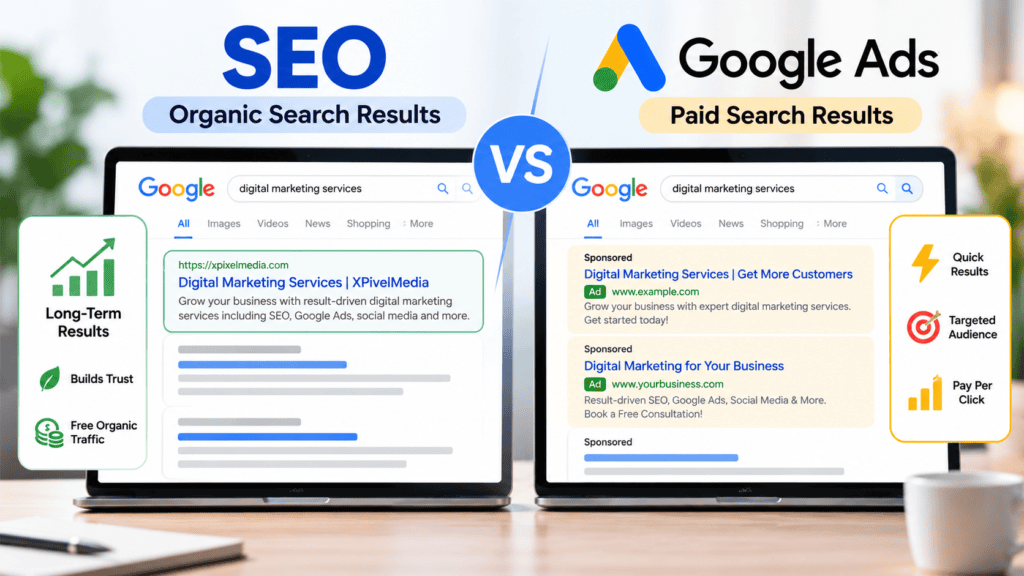
SEO vs Google Ads: Which Works Better for Cost and Results?
The main difference is how you invest your money and time.
SEO requires investment in content, technical improvements, and optimization. You may not pay for each organic click, but SEO still has costs, including your time or the fees charged by professionals.
Google Ads requires an advertising budget. You pay for clicks or other campaign actions according to your campaign’s bidding model. Results can arrive faster, but profitability depends on how efficiently your campaign converts visitors into customers.
Consider these factors when comparing the two approaches:
| Factor | SEO | Google Ads |
|---|---|---|
| Initial visibility | Usually gradual | Can be faster |
| Traffic cost | No direct payment per organic click | Paid advertising costs |
| Long-term potential | Can build lasting visibility | Usually depends on continued spending |
| Budget control | Investment varies by strategy | Campaign budgets can be set |
| Best suited for | Sustainable organic growth | Faster, targeted traffic |
Neither option guarantees sales. Both require relevant keywords, useful content, a good website experience, and clear conversion goals.
When Should You Choose SEO?
SEO can be a suitable choice if your goal is to build long-term online visibility. It is especially useful for businesses that want to attract customers through educational content and organic search results.
Consider prioritizing SEO when:
- You want to reduce dependence on paid advertising over time.
- Your customers regularly search for information related to your services.
- You can invest time in creating useful website content.
- You want to build authority in your industry.
- You are willing to work consistently without expecting immediate results.
For example, a local service provider can publish helpful guides, optimize service pages, and improve its Google visibility to attract relevant visitors over time.
Read Google’s SEO Starter Guide to understand the fundamentals of search optimization.
When Should You Choose Google Ads?
Google Ads may be more appropriate when you need visibility quickly and have a clear offer to promote.
Consider using Google Ads when:
- You are launching a new service or product.
- You need to generate leads within a shorter timeframe.
- You want to test demand for a particular service.
- Your business has a defined advertising budget.
- You can track enquiries, purchases, and other meaningful conversions.
For instance, a website design company can run search ads for customers actively looking for website development services.
However, do not judge a campaign only by clicks. Track qualified leads, conversion rates, cost per lead, and actual sales to determine whether your advertising is profitable.
You can explore campaign options through the official Google Ads website.
Can You Use SEO and Google Ads Together?
Yes. In many cases, combining both strategies can support a stronger digital marketing plan.
Google Ads can help you test which search terms attract relevant visitors and enquiries. Those insights may help inform your SEO content strategy, although paid advertising does not directly improve organic rankings.
Meanwhile, SEO can build organic visibility while paid campaigns target selected searches and offers.
For example, a small business could use Google Ads to promote its main service while publishing informative blogs and optimizing its service pages for organic search.
If you are improving your website, explore the digital marketing services offered by XPixelMedia to understand how different online marketing activities can support business growth.
How to Choose the Right Strategy for Your Business
Before investing, answer these questions:
- How quickly do you need results? Paid search can offer faster visibility, while SEO generally requires patience.
- What is your available budget? Consider advertising costs alongside the time and resources required for SEO.
- What are your business goals? Lead generation, immediate sales, and long-term brand visibility may require different approaches.
- Can your website convert visitors? A clear offer, relevant landing page, and simple contact process matter for both strategies.
- How will you measure success? Set measurable goals such as qualified leads, purchases, and return on advertising spend.
Your decision should be based on business performance rather than traffic numbers alone.
Conclusion
SEO vs Google Ads: Which Works Better? There is no single answer for every business. SEO is useful for developing long-term organic visibility, while Google Ads can help you reach potential customers more quickly through paid placements.
If you have a limited budget and can invest consistently in content and optimization, SEO may be a sensible starting point. If you need faster visibility and can measure campaign profitability, Google Ads may be appropriate. Businesses with sufficient resources can combine both approaches.
The best strategy is the one that attracts relevant visitors, converts them into customers, and supports your business goals over time.
