Most businesses need an online presence to reach customers today. A website and social media pages are a good start. But they are not enough on their own. Businesses also need a clear plan to reach the right people and turn them into customers.
So, what does a digital marketing agency do?
A digital marketing agency helps businesses promote their products or services online. It uses channels such as Google, social media, websites, email, and online ads.
An agency can help a business:
- Get more visitors to its website
- Reach more potential customers
- Generate leads
- Increase online sales
- Improve brand awareness
- Get better results from online ads
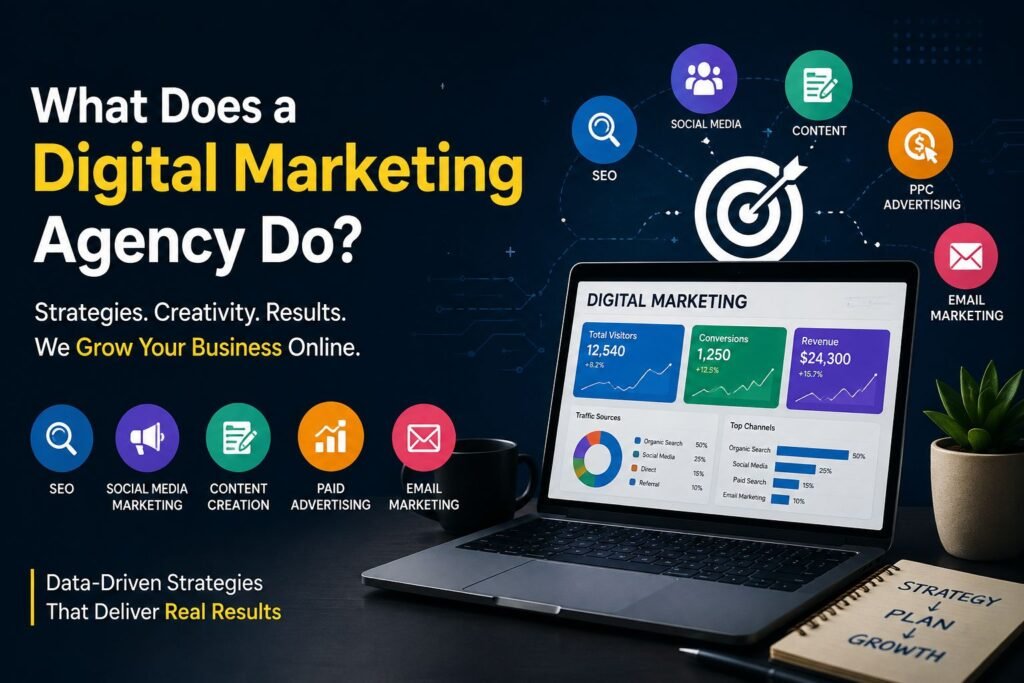
Digital marketing agencies use different methods to reach these goals. These methods include SEO, Google Ads, social media marketing, content marketing, email marketing, and website optimization.
An agency also tracks the results of its work. It checks things such as website traffic, leads, sales, and ad performance. It then uses this data to improve the marketing strategy.
For example, imagine you own a local gym. You want more people in your area to join your gym. A digital marketing agency could help your gym appear on Google when people search for a gym nearby. It could also run Google Ads, manage your social media pages, and create content for your website.
The goal is simple: help the business reach more potential customers and grow online.
In this guide, we will explain what a digital marketing agency does, what services it offers, how it works, and why businesses hire one.
For detailed info visit wikipediahttps://en.wikipedia.org/wiki/Wiki
What does a Digital Marketing Agency do ?
A digital marketing agency is a company that helps businesses market themselves online.
Traditional marketing uses channels such as newspapers, TV, radio, and billboards. Digital marketing uses online channels instead.
A digital marketing agency helps a business choose the right online channels. It then creates and manages marketing campaigns on those channels.
For example, an agency may help a business with:
- Search engine optimization (SEO)
- Google Ads
- Social media marketing
- Content marketing
- Email marketing
- Website design
- Online reputation management
- Conversion rate optimization
Not every business needs all of these services. The right services depend on the business and its goals.
For example, a local dentist may focus on local SEO and Google Ads. An online clothing store may focus more on social media ads, SEO, and content marketing.
What Does a Digital Marketing Agency Actually Do?
The work of a digital marketing agency usually follows a simple process.
1. Understand the business
The agency first learns about the business. It looks at the products or services, target customers, competitors, and business goals.
2. Create a marketing plan
Next, the agency chooses the right marketing channels. It may use SEO, social media, paid ads, content, or a mix of different methods.
3. Run the campaigns
The agency then puts the plan into action. This may include creating content, optimizing a website, running ads, or managing social media.
4. Track the results
The agency checks how well the campaigns are performing. It may track website visits, leads, sales, ad clicks, and conversions.
5. Improve the strategy
Digital marketing requires regular testing and changes. If something is not working, the agency looks at the data and makes changes.
For example, an agency may find that one Google Ad gets more leads than another. It can then move more of the budget to the better-performing ad.
This is why a digital marketing agency does more than just post on social media or create advertisements. Its job is to use online marketing channels to help a business achieve specific goals and measure the results.
What Services Does a Digital Marketing Agency Offer?
Digital marketing agencies offer different services based on the needs of a business. Some agencies focus on one service, while others offer a full range of digital marketing services.
Here are some of the most common services offered by digital marketing agencies.
1. Search Engine Optimization (SEO)
SEO helps a website appear higher in search engine results.
For example, a person may search for “best digital marketing agency in Delhi.” SEO helps a business improve its chances of appearing in those search results.
An agency may work on:
- Keyword research
- Website content
- Page titles and headings
- Website speed
- Technical SEO
- Internal links
- Local SEO
- Backlinks
The main goal of SEO is to bring organic traffic to a website. Organic traffic comes from search results without paying for every click.
SEO usually takes time. But a well-optimized website can continue to bring traffic over the long term.
2. Pay-Per-Click (PPC) Advertising
PPC is a form of paid online advertising. Businesses pay when someone clicks on their ad.
Google Ads is one of the most common PPC platforms.
For example, a person searches for “buy running shoes online.” A shoe store can run a Google Ad that appears for this search.
A digital marketing agency can help with:
- Keyword research
- Ad creation
- Audience targeting
- Budget planning
- Landing pages
- Conversion tracking
- Campaign optimization
PPC can bring traffic faster than SEO. However, the business needs to keep spending money to continue running the ads.
3. Social Media Marketing
Social media marketing helps businesses reach customers on platforms such as Instagram, Facebook, LinkedIn, and YouTube.
An agency can create a social media plan based on the target audience and business goals.
Its work may include:
- Creating social media posts
- Making short videos and reels
- Planning content
- Managing social media accounts
- Responding to comments and messages
- Running paid social media ads
- Tracking results
For example, a clothing brand can use Instagram Reels to show new products. It can also use Instagram ads to reach people who may be interested in those products.
4. Content Marketing
Content marketing means creating useful content for a target audience.
The content can include:
- Blog posts
- Videos
- Social media posts
- Guides
- Infographics
- Case studies
- E-books
For example, a fitness company can publish a blog about “how to start working out as a beginner.”
This type of content can attract people who are interested in fitness. Some of these visitors may later become customers.
Content marketing also supports SEO. Useful and well-structured content can help a website rank for relevant search terms.
5. Website Design and Optimization
A digital marketing agency may also help businesses improve their websites.
A website should not only look good. It should also be easy to use and help visitors take action.
An agency may work on:
- Website design
- Mobile-friendly pages
- Landing pages
- Page speed
- Navigation
- Call-to-action buttons
- Contact forms
- Conversion rate optimization
For example, if many people visit a website but very few contact the business, the agency may check the website and find ways to improve the conversion rate.
The goal is to turn more website visitors into leads or customers.
6. Email Marketing
Email marketing helps businesses communicate directly with their customers and leads.
An agency can create and manage:
- Newsletters
- Promotional emails
- Welcome emails
- Product updates
- Follow-up emails
- Automated email campaigns
For example, an online store can send an email to a customer who added a product to their cart but did not complete the purchase.
Email marketing can help businesses increase sales and stay connected with existing customers.
7. Online Reputation Management
A business’s online reputation can affect how people see its brand.
Digital marketing agencies can help businesses manage their online reputation. This may include monitoring reviews, responding to customer feedback, and encouraging satisfied customers to leave reviews.
This is especially useful for local businesses such as:
- Restaurants
- Hotels
- Clinics
- Salons
- Gyms
- Local service providers
Positive reviews can help build trust with potential customers.
8. Analytics and Reporting
A digital marketing agency also needs to measure its results.
It may track metrics such as:
- Website traffic
- Leads
- Sales
- Conversion rate
- Cost per lead
- Ad clicks
- Return on ad spend (ROAS)
- Search rankings
Tools such as Google Analytics, Google Search Console, and advertising platforms can provide this data.
The agency uses these numbers to understand what is working and what needs to change.
For example, if an ad receives many clicks but produces very few leads, the agency may need to change the ad, targeting, or landing page.
This makes digital marketing a data-driven process. Agencies do not just launch campaigns and leave them running. They monitor the results and make changes based on the data.
i hope you have understood that ” What Does a Digital Marketing Agency Do”
For More Info Check Our Home Page and Services Page
